Published: February 12, 2024
Breaking the Myths About Lifting Weights
Many beginners avoid strength training because of common misconceptions. Some fear that lifting weights will make them look bulky, while others believe it is only for young athletes. The truth is that strength training benefits everyone, regardless of age, gender, or fitness level.
Research consistently shows that resistance training improves bone density, boosts metabolism, enhances mood, and reduces the risk of chronic diseases. For those looking to lose weight, building muscle is one of the most effective strategies because muscle tissue burns more calories at rest than fat tissue.
Understanding the Basics
Before you pick up your first dumbbell, it is important to understand some fundamental concepts:
- Repetitions (reps): The number of times you perform a single exercise movement
- Sets: A group of consecutive repetitions. For example, 3 sets of 10 reps means performing 10 repetitions three times with rest between each set
- Progressive overload: Gradually increasing the weight, frequency, or number of repetitions to continuously challenge your muscles
- Rest periods: The time you take between sets to recover, typically 60 to 90 seconds for beginners
- Form: The proper technique for performing an exercise, which is crucial for preventing injuries
Essential Exercises for Beginners
Focus on compound movements that work multiple muscle groups at once. These exercises give you the most benefit in the least amount of time:
Upper Body
- Dumbbell chest press: Targets chest, shoulders, and triceps. Lie on a bench or the floor with a dumbbell in each hand. Press the weights up until your arms are straight, then lower them slowly.
- Bent-over rows: Targets back and biceps. Hinge at the hips holding dumbbells, pull them toward your ribcage, and lower them with control.
- Overhead press: Targets shoulders and triceps. Stand with dumbbells at shoulder height and press them overhead until arms are fully extended.
Lower Body
- Goblet squats: Hold a single dumbbell close to your chest while performing a squat. This helps maintain proper form and upright posture.
- Romanian deadlifts: Hold dumbbells in front of your thighs, hinge at the hips while keeping a slight bend in the knees, and lower the weights along your legs.
- Step-ups: Step onto a sturdy elevated surface while holding dumbbells, then step back down. Alternate legs each repetition.
Core
- Plank: Hold a straight body position supported by your forearms and toes
- Dead bugs: Lie on your back and alternately extend opposite arm and leg while keeping your lower back pressed to the floor
Your First 4-Week Program
Train three days per week with at least one rest day between sessions. Start with weights that allow you to complete all repetitions with good form while feeling challenged on the last two reps.
- Weeks 1-2: 2 sets of 10 reps for each exercise, 90 seconds rest between sets
- Weeks 3-4: 3 sets of 10 reps for each exercise, 60 seconds rest between sets
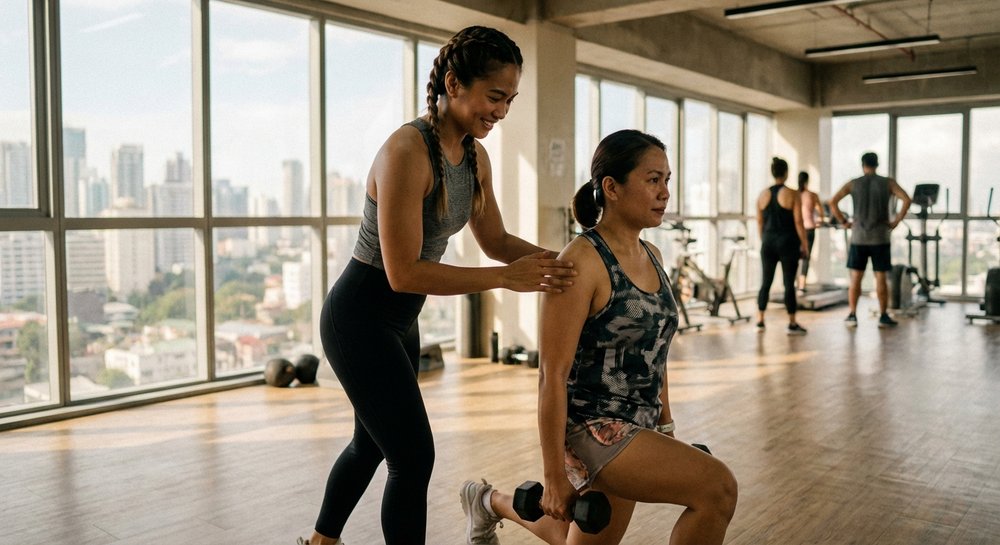
The goal is not to lift the heaviest weight possible but to lift the right weight with perfect form. Mastering technique now will set you up for years of safe and effective training.
Common Mistakes to Avoid
- Skipping the warm-up: Always spend 5 to 10 minutes warming up before lifting
- Lifting too heavy too soon: Progress gradually to prevent injuries
- Neglecting form for heavier weights: Quality always trumps quantity
- Not eating enough protein: Your muscles need protein to recover and grow. Learn more about building a balanced diet
- Ignoring rest days: Muscles grow during recovery, not during the workout itself
Starting a strength training program can feel intimidating, but with the right guidance and a consistent approach, the results will speak for themselves. If you want personalized coaching to ensure you are training safely and effectively, our personal training team at FitLife Wellness is here to help.